
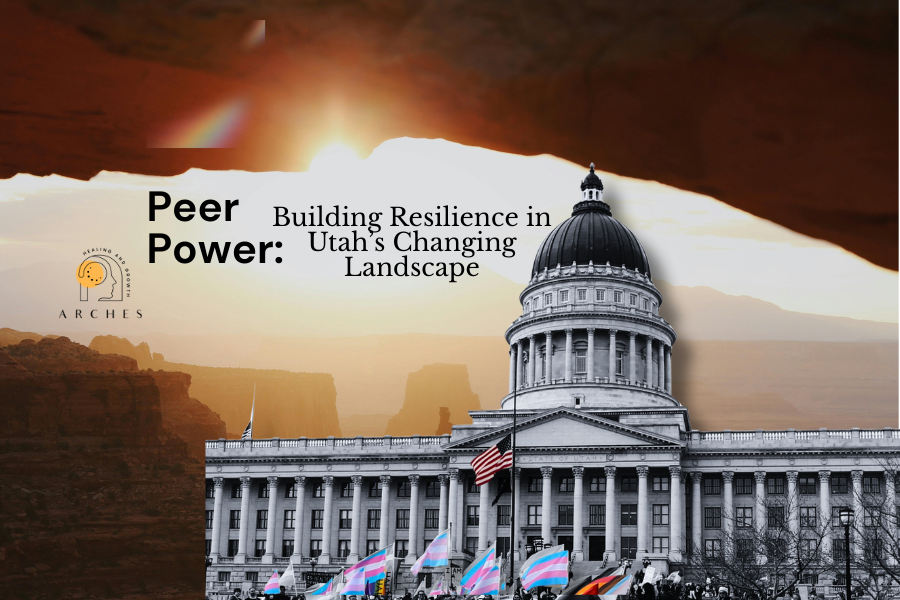
Peer Power: Building Resilience in Utah’s Changing Landscape
By Sneha Pusapati.
Utah’s queer and BIPOC communities are navigating a shifting landscape where legislative changes have heightened barriers to care, but grassroots and peer-led mental health support remain powerful tools for resilience.
Below are a few examples of local legislation that have been passed since 2020:
HB257 (2024): This bill restricts access to sex-designated privacy spaces, like restrooms, locker rooms, changing rooms, and dorm rooms
HB77 (2025): This bill bans LGBTQ+ flags from being displayed in public schools and government buildings in the name of "neutrality".
HB261 (2024): Utah lawmakers have advanced several bills curtailing diversity, equity, and inclusion programs, reducing institutional support for BIPOC and queer students
Loss of public assistance for low-income families: Local bipartisan lawmakers have consistently supported state and federal legislation that negatively impacts children and low-income families.
HB226 (2025): Encourages migrants who are imprisoned for misdemeanors to directly enter deportation proceedings when their sentence ends.
These policies don’t just exist on paper; they ripple into everyday lives, shaping access to care, school safety, and the visibility of affirming spaces. For queer BIPOC Utahns, the intersection of racism, homophobia, and transphobia compounds these challenges.
Community Mental Health Support
While policy can restrict formal systems of care, community-led initiatives often step in to fill the gap:
Peer Support Networks: Informal groups, whether organized through churches, cultural centers, or local collectives, offer safe spaces to share experiences, validate identities, and reduce isolation. Examples include the Trans and Nonbinary Support group at Arches, D&D/Board Game nights at Legendarium, or 999 RideSLC.
Grassroots Healing Circles: BIPOC and queer organizers in Utah have created healing circles using art, storytelling, and movement to process trauma collectively. These culturally resonant practices affirm identities often overlooked in mainstream therapy. Examples include NuaNua Collective and Urban Indian Center of Salt Lake.
Sliding-Scale and Intern-Led Therapy: Clinics and nonprofits are expanding access by offering reduced-cost sessions through supervised interns, making therapy more affordable for marginalized communities.These options are offered at Arches!
Mutual Aid and Resource Sharing: Beyond traditional therapy, mutual aid networks provide essentials like housing support, food, and transportation, all of which are critical for mental health stability. The Food Justice Coalition and Asian Association of Utah have been engaging in this work for years!
Utah has seen a growing number of affinity groups and culturally informed spaces established by community members who recognize the need for them. These spaces are not necessarily advertised or “google-able,” and often depend on word of mouth to reach their audience. Reach out to community leaders, cultural centers, or explore social media pages to identify places of shared experience.
Peer Mental Health Support
Peer support is more than friendship; it’s structured care rooted in shared experience. It’s not about a professional “fixing” someone, it’s about mutual connection and solidarity. This can look like:
checking in on a neighbor in need,
sharing groceries
Texting a family member you’ve been thinking about
Offering professional services for free, if you are able to
storytelling and finding shared meaning with friends
You don’t have to be talking to be supportive.
Sharing art, music, food, or cultural rituals can be deeply healing.
Finding someone younger or newer to a community space and pairing with them can offer guidance and affirmation.
Offering someone a ride or accompanying them to stressful medical appointments speaks volumes
Visible signs of support like wearing a pin, having a sign on your door, or leaving a note indicates solidarity
As the 2026 legislative season approaches, being active, visible, and finding joy is more important than ever. While we may not always have access to structured or professional services, we do have access to the people around us. Peer support is truly about showing up; it doesn’t take professional skills, just commitment and compassion. While the world has told us to constantly focus on ourselves, our well-being, and our boundaries, it is equally, if not more important, to consider the collective well-being of the places we live in and the people we see. Legislation may restrict access, but community resilience is unstoppable.
